Showing posts with label Libya. Show all posts

Thursday, August 2, 2012

Nigerians Are Dying In Libyan Prisons, Say Returnees


A terrified Nigerian youth is arrested by Libyan troops. When war broke out last year in Libya, the rebels labeled Black people “mercenaries” of Qaddafi. Thousands were lynched or imprisoned and tortured, whether they were Libyan-born or had come from sub-Saharan Africa to work. The end of the war did not end the persecution of Blacks.

BY KAYODE OGUNWALE/SAN FRANCISCO BAY VIEW

Lagos – Nigerians who were recently repatriated from crisis-torn Libya described their ordeal after they were caught between two feuding camps.

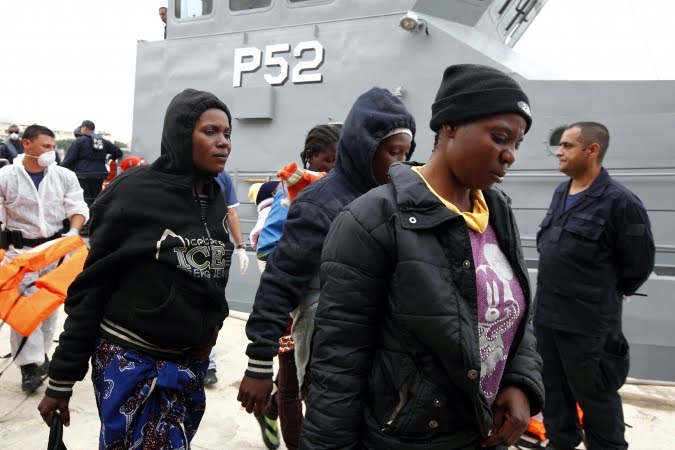
Their appearance tells the story of the ordeals they went through in their host country. The 327 Nigerians who were recently evacuated from Libya wear the scar like a toga. Disheveled, disillusioned and angry, the returnees – men, women and children – arrived at the Murtala Mohammed International Airport in mid-July in two batches on board a Tripoli Air Memphis Subme plane.

The stranded Nigerians, according to the National Emergency Management Agency (NEMA), were evacuated to the country from Libya through the effort of the International Office for Migration (IOM), a United Nations body.

Statistics by the agency indicate of those brought back, 113 are females and 214 males. Among them also are 11 under-aged children and one elderly person.

Weekly Trust learnt that some of the returnees had been tortured or imprisoned by the new government in Tripoli before they were evacuated. Some of them who relived their experiences painted a gloomy picture of the post-Qaddafi era. They had been caught in the crossfire there.

Mr. Okwudolor John said, “The situation is very bad in Libya. Nigerians are suffering; some are very sick while others are dying.

“We lost everything during the crisis: money, clothes, everything indeed. Libyan hoodlums capitalized on the crisis to rob and dispossess us of our property.”

Esther Omoreghe, who returned with two of her children while her Ghanaian husband and her son died in the heat of the crisis, regretted her sojourn to a foreign land and vowed that she would never allow her children or relations to travel outside Nigeria.

A returnee simply identified as Jennifer, who could not hold back tears, said she left Nigeria in search of greener pastures, but came back dejected with a pregnancy.

“We lost everything during the crisis: money, clothes, everything indeed. Libyan hoodlums capitalized on the crisis to rob and dispossess us of our property.”

“The Nigerian government should wake up, because so many of us are dying in Libyan prisons. Libyans do not want to see us at all.

“If you have somebody in Libya and have not heard from the person for a long time, just know either the person is dead or in one of the prisons,” she said.

Jennifer said the person responsible for her pregnancy, a Nigerian, was in one of the unknown prisons.

Miss Idemudia Joy said her travelling to Libya was a “wasted effort,” blaming the different levels of governments in the country for her predicament.

“I think if everything had been well in Nigeria, none of us would want to go through hell on earth. I went to Libya through the desert. I trekked night after night through the desert, but see where I have ended up. But I still thank God I came back complete and was not detained endlessly in their prisons. Here I can start a small business to take care of my baby and myself,” she said. “If you have somebody in Libya and have not heard from the person for a long time, just know either the person is dead or in one of the prisons.”

Idemudia urged the federal government to expedite action to evacuate Nigerians from Libyan prisons and hospitals and those hiding in different villages.

One of the returnees, who came home with POP on his leg, said he was shot by a security officer while doing his business in the crisis-torn country. He said there was an increasing hatred for Nigerians and appealed to the federal government to act fast to save young Nigerians in Libya.

“The government should stop saying there are no Nigerians in Libya. There are many of us in prisons, hospitals and some doing odd jobs for companies, just to find a place to hide,” he said.

A NEMA official who spoke on condition of anonymity said it is not only Libya that is repatriating Nigerians. “On March 7, 2011, at the peak of crises in some parts of North Africa, NEMA in collaboration with the International Organization for Migration (IOM) and other partners repatriated about 991 Nigerians, mainly from Egypt and Tunisia, while on the Feb. 27, 2012, about 292 Nigerians returned from Libya to Lagos.

Also, 423 Nigerian returnees were received by NEMA at the border town of Gamboru-Ngala in Borno State in four batches in 2011.

Altogether, over 3,000 Nigerian victims of the Arab Spring crises, he said, have been repatriated to Nigeria by NEMA and other international and national humanitarian organizations. The first batch returned at the peak of the Tunisian and Egyptian crises when many nationals were trapped in those crisis torn countries.

He said many Nigerians could not be evacuated then, because most of them could not be reached at the time of the scheduled evacuation, as most of them were living in the rural and remotest areas in those countries.

Another hindrance in reaching Nigerians at the time, he said, was that many of them could not access mass communications like social media, radio and television that were deployed by the Nigerian embassies and NEMA to inform the distressed Nigerians on the assembly points for their evacuations.

“It’s pertinent to stress that most of those who turned up for evacuation earlier later turned down the opportunity to return to Nigeria, and with the humanitarian principle of non-compulsion to force people to reside against their place of choice, the Nigerian government was compelled to leave the Nigerians who decided to remain until they voluntarily opted to return to Nigeria.

“The current returnees may be part of those who refused to return at the initial time, while more of them may turn up for eventual return when they feel like returning to their fatherland, he said.”

In Libya, 327 Nigerians await flights to take them home. Some had not heard of earlier opportunities to leave, and others had chosen to stay, hoping for an end to the persecution of Blacks.

Sunday, September 4, 2011

Migrants In Libya Claim Rape


By Evan Hill, English Al Jazeera


Migrant workers living in a squatter settlement outside Tripoli have claimed that nearly two dozen women in the camp have been raped since opposition forces began their final push on the capital two weeks ago.


At the abandoned fishing harbour about 27km west of Tripoli, Nigerian maids Rose Johnson and Darcy Ikibueka said on Monday they are two of more than 20 women in the camp who have been raped by armed men whose identities and affiliations remain unknown.


The names of the women have been changed to protect their identities.


The claims were bolstered by aid workers from Doctors Without Borders (MSF) who gained access to the camp on Saturday. Simon Burroughs, MSF emergency coordinator, said women had approached the staff with claims of rape and had received counselling.


Burroughs declined to say how many women had alleged rape or to discuss their testimony, specifically the women’s accusations about who was responsible.


"They're not free to talk about it. It’s the situation they're in," Burroughs said. "[But] we have to take the allegations seriously, we can’t discount them. This is not the environment for the kind of care and attention they need."


Gunmen attack


Sitting on plastic chairs in an unfinished, rubbish-filled concrete room inside the decrepit harbour headquarters, Johnson, 25, and Ikibueka, 22, told Al Jazeera of how they worked together in the same Tripoli household. They had lived in Libya for two years and came to the port in June.


Like hundreds of other migrants from Nigeria, Chad, Senegal and other impoverished African countries, they had fled to the camp to escape NATO bombings and impending street battles.


The port had in recent months become a hub for human traffickers whose business of smuggling migrants into Europe, usually by way of the Italian island of Lampedusa, boomed when Gaddafi opened the illegal immigration floodgates.


In an interview with the Italian radio station Rai, Hafez Gaddour, Libyan ambassador to Italy, said Gaddafi controlled illegal immigration "in person". The ambassador, who defected to the National Transitional Council (NTC) earlier this year, added that the flood of immigrants was meant to punish NATO nations for its bombing campaign.


These days, hundreds of men and women live in the shade of tilting fishing boats. On Monday, the migrants were cooking goat heads over small wood fires, braiding each other’s hair, and playing draughts with water bottle caps. Many speculated on the whereabouts of friends and family lost in the chaos of Tripoli.


On the night of August 19, gunmen entered the harbour camp. They fired their guns in the air, shouting "God is great". That night, Johnson and Ikibueka said, they were raped at gunpoint.


Anthony Ogiexeri , a 37-year-old Nigerian pastor who lives in the camp, gave Al Jazeera this account:


"The came in, some of them they were shooting all around, and they ordered girls to come out. [When] they came out, they laid them down. Some of them were saying they should allow the girls [to] go, and some of them said, 'No, they were going to rape them'. And at the end they submitted to the men, and they raped them. And after they left."


'Dark places'


Johnson, Ikibueka and several male refugees alleged the attackers were rebels who shouted slurs against Gaddafi. At the time of the alleged rapes, the camp lay in contested territory.


But Ogiexeri said he could not tell who had carried out the attacks. It is possible that forces on either side in the conflict, or even unallied gunmen, could have stormed the harbour camp.


Rebel forces do not obey one single line of command, making it difficult to determine what units where in the camp's vicinity at the time. Efforts to reach representatives of the National Transitional Council on Monday night were unsuccessful.


Regular visits from armed gangs have slowed in the three days since the MSF team arrived, Burroughs said. Yet he was still concerned about the security at the port and worried that publicising the women's testimony could lead to reprisals.


Johnson and Ikibueka estimated that 25 to 30 women had been raped in the camp. It was impossible to verify that number during Al Jazeera’s visit, but an aid worker who declined to be named said it was close to the organisation’s estimate.


Migrants and aid workers said the threat of violence still remains.


Some Libyans have donated food and supplies to the camp, but in recent days, groups of armed men and boys have regularly entered the camp at night, robbing the refugees of food and money.


They also take women away to use them for sex, Ogiexeri said.


"We try to connect lights so we can see ourselves at night, but they take them to the dark places."

Thursday, September 1, 2011

Suffering Amid Libya's Growing Human Disaster

Ahmed Ali, set alight during an apparent racist attack near his home, had been held in a Tripoli jail without access to treatment

A Farm Weekly Report


BEHIND 2.4-metre iron gates, along a sandy path and up concrete stairs, there is a glimpse into the humanitarian disaster that is unfolding in newly liberated Libya.


About 300 prisoners, some crowded into cells housing 26 men at once, are being held in Maftuh Jail in Fernaj, a district of Tripoli.


According to the police officer who took over the prison from rebel soldiers on Tuesday, the men were swept up in the rebels' August 20 push to take Tripoli. Most are accused of being mercenaries fighting for Muammar Gaddafi. Most deny the allegations.


After 11 searingly hot days held in unsanitary, overcrowded cells with no running water, the men were desperate for help. They asked for doctors, lawyers and humanitarian workers to come to the prison.


But further down the corridor, we found two young men in an even more desperate situation. His face burnt, peeling and blistered, 28-year-old Ahmed Ali from Nigeria was in need of urgent medical help.


''Nine days ago, some youth near my house got angry - they came to my place and they poured fuel on me,'' he said, bracing himself against a wave of pain.


They set him on fire in an apparent racist attack that has become increasingly common in a country harbouring so much anger against Gaddafi and his mercenaries. Anyone with dark skin - regardless of their loyalties - can find themselves a target. Ahmed has been held here without any medical care - directly across the road from one of Tripoli's largest hospitals.


Another young man in his cell, Mustafa, from Nigers, held up a badly bandaged left hand. Three of his fingers had been blown off by a bullet. He had received no medical care for his injuries.


When confronted about these two prisoners, the officer in charge, Anwar Bin Naji, told The Age: ''The whole of Tripoli is in a difficult situation - the entire system has broken down. Come back in four days, you will find a very different place.''


But why not call a doctor from Tripoli General Hospital, not 500 metres away? ''There are not enough doctors in Tripoli - they have been working around the clock for days,'' he replied.


After some convincing, he pulled his phone out and called the hospital. And he agreed that if The Age could get a doctor to the prison, he would let them in. We contacted Salama Agni, a general surgeon from the hospital, who arrived 20 minutes later. The two badly injured prisoners were brought to the jail's clinic for treatment.


''This man needs to go to a burns hospital,'' Dr Agni said. ''His burns need to be hydrated, and he needs intravenous antibiotics.''


As the doctor smoothed salve onto the wounds on his face, neck and knee, Ahmed explained he had been in Libya for two years, and worked in interior design after doing an architecture course in Nigeria. ''I am not a fighter,'' he said. ''I don't even own a knife.''


Human Rights Watch and Amnesty International have been warning of mounting evidence of human rights abuses against dark-skinned Libyans and sub-Saharan Africans ''who have frequently been accused of serving Gaddafi as foreign mercenaries''.


They have urged the de facto government in Libya to treat all detainees in accordance with international human rights and humanitarian law standards, including prompt review before an independent judicial panel and immediate access for the International Committee of the Red Cross to all detainees in Transitional National Council custody.