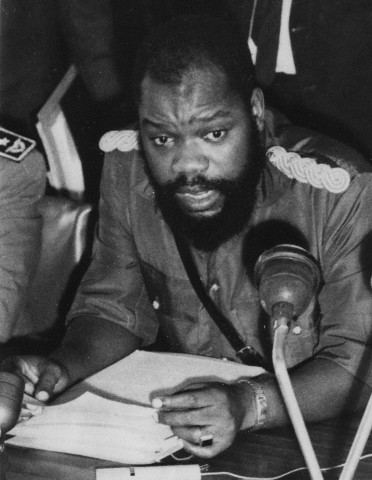
By Anthony Akaeze and Sebastine Obasi/Newswatch
Contending groups in the larger Ojukwu family make claims and counter claims over ownership of properties and the paternity of a member allegedly born out of wedlock.
He walked into Newswatch office that May 14, betraying no sign of anxiety. But it was soon clear, once the interview began, that the man was much eager to dispute or refute some of views contained in a recent interview granted Newswatch magazine by another member of the family, Debe Odumegwu-Ojukwu. Ike Ojukwu, son of Joseph Odumegwu-Ojukwu, who is the first son of Louis Philip Odumegwu- Ojukwu, said most of the views of Debe as contained in the May 7, issue of the magazine were either factually incorrect or did not reveal the true situation of things in the family. Although he acknowledged that there was a lingering court case involving members of the family over their patriarch’s property, he did not consider it unusual because disagreement is common among families. To that extent, “there’s no war with anybody.”
But Ike, who is an obstetrician and gynaecologist, took exception to the words “natural child” as expressed by Debe during the interview.
In the interview, Debe, in reply to a question said that his father, Emeka Odumegwu-Ojukwu and former Biafran leader, was the “only natural child of Sir Louis Odumegwu-Ojukwu.” This claim, Ike said, is far from the truth. On the contrary, Ike said that his father’s position as first son of the late Louis Odumegwu Ojukwu has never been in doubt even while his grandfather was alive. He brought to the interview documents showing that his father, Joseph, had been a board member of his father’s company since the 50s.
Beyond that, Ike said his father enjoyed the best care and upbringing from their father and that his grandmother, Ogbenyealumalize, was his grandfather’s first wife. “My father was born here in Nigeria. I don’t remember his primary school, but I know he went to King’s College. He not only went to King’s College, he went to Cambridge; my grandfather paid his school fees. This company we are talking about, he’s been a director since 1952…now I don’t know anywhere in Nigeria where somebody will send you to King’s College in the 30s, send you to Cambridge in the late 30s, and you’ve been a director of the company for 60 years, this year and you are the only son that’s an executor of his will” and not considered his natural son.
Ike added that, if there’s anything as unnatural son, it best fits Debe. Debe, he said, contrary to his claims, was never acknowledged by Ojukwu, the late Biafran leader, as his first son. He alleged that Ojukwu, the Ikemba Nnewi, some years ago, told his extended family members called Umunna, that his first son is Emeka Jnr.
Ike also addressed the issue of his grandfather’s property many of which are sited in Lagos. He said that, although the late Ikemba Nnewi lived in Villaska Lodge, the property and others do not belong to him. “Not one of these properties belong to Emeka Ojukwu, my uncle. They belong to the company, Ojukwu Transport Company and the gazettes prove this and he acknowledged that…It’s a family thing. Everything belongs to the family,” he said.
But the family properties have since been a subject of litigation in the law court and the parties involved are Debe Odumegwu-Ojukwu on the one hand, and Ojukwu Transport Limited, represented by the children of Sir Louis Philip, on the other.
How did things get to this point? Newswatch learnt that Debe, who’s a former police officer and lawyer, was the person in charge of managing the family’s property until things suddenly fell apart between the two parties. Ike told Newswatch that the Ojukwu Transport Company engaged Debe to manage the family’s property with the agreement that he would take 30 percent of the proceeds, but that, Debe, till date, had not remitted any money to the family. He stated that it was Emmanuel Odumegwu Ojukwu, his uncle, who offered Debe the opportunity to take charge of their father’s property but that he has since failed to fulfill his own part of the agreement. Evidence of this strained relationship came to public light in an advertorial that appeared in February 22, 2008, in the Daily Sun newspaper asking tenants in the houses managed by Debe, to desist from dealing with him. “The general public and particularly the tenants occupying the following houses owned by Ojukwu Transport Limited…by this notice… are warned that the company has, by resolution, appointed the firm of Massey Udegbe & co to manage the above listed properties. Any person who deals with any other person and more particularly, the firm of Mrs Ogbonna Ojukwu & associates and or Debe Odumegwu-Ojukwu in respect of the above mentioned properties, does so at his own risk,” the disclaimer read.
One of the properties in question, which according to a source, has remained unoccupied till date is located at 29 Queens Drive. The property is called Villaska Lodge, and was where the late Biafran leader lived before he relocated to Enugu. According to Lotanna, one of the sons of Sir Louis Philip Odumegwu-Ojukwu, the property had remained uninhabited since the late 1990s that Ojukwu moved to Enugu. Lotanna told Newswatch that he visited Villaska Lodge some months ago, and that when he got there, the gateman was not there. So he went inside. But the gateman, he said, soon appeared and locked the gate, leaving him trapped. Lotanna asserted that he and his driver and one other person who accompanied him, now had to force the gate open for him to come out. Following that, Lotanna said the gateman contacted Emeka Jnr and Bianca who now mobilised members of the Movement for the Actualisation of the Sovereign State of Biafra, MASSOB, to guard the place. He noted that the house requires renovation and that it would better benefit the family if repairs are carried out on it.
Lotanna is one of the defendants in the pending court case at a Lagos High Court. Others are Ojukwu Transport Limited, Professor Joseph Ojukwu, Emmanuel Ojukwu, Dim Chukwuemeka Odumegwu-Ojukwu and Massey Udegbe. Listed as claimants in the case are Ogbonna Ojukwu and Associates, Debe Odumegwu-Ojukwu and Silver Convention. One of the lines of the suit with No: LD/794/2011 dated 6 October 2011 read: “… despite the fact that there was an agreement between the Claimants and the 1st Defendant to manage the properties listed in the schedule of the Management Agreement dated 1/6/1995, most of the rents were either collected by the 1st –5th Defendants personally despite the 2nd Claimant’s protest that some of the properties in question were never released to the Claimants as they were personally occupied by some of the Defendants herein.” Part of the claimants claim is that “most of the properties in contention were derelict and dilapidated and taken over by known and unknown persons before the Claimants were engaged whilst various sums of money were expended to recover and put them in tenantable situation without being reimbursed by the 1st Defendant for that purpose.”
That Emeka Odumegwu-Ojukwu’s name appears on the list of defendants might be only due to the fact that he’s a director in Ojukwu Transport Company as some of the expressions tend not to only exonerate him, but give the impression that it is his interest that is being championed: “Rather than for the Defendants, excepting the 3rd, (Emeka Ojukwu) to see reasons why terminating the management agreement would be unjust and inequitable in the circumstance, they went ahead to appoint/nominate the 6th defendant to take over the management functions from the 1st claimant thereby jeopardising the financial/vested interest and equitable right of the claimants in the said properties.” Furthermore, “the actions of the defendants, excepting the 3rd, in deliberately denying the claimants of their dues and returns on investments is also actuated by malice, ill feeling and family vendetta against the 2nd claimant (Debe) and his father the 3rd defendant.”
Apart from Villaska Lodge, some other houses cited in the suit include: 132 Agege Motor Road, Lagos, 19 Mekunwen Street, Ikoyi, Lagos, 15 Oshodi Street, Lagos, 32 Commercial Road, Yaba, Lagos, 388B Herbert Macaulay Street, Yaba, Lagos, 32 Gerrard Road, Ikoyi, Lagos, 13 Hawksworth Street, Ikoyi, Lagos, and 4 Macpherson Road, Ikoyi, Lagos. All these constitute just a fragment of Sir Louis Odumegwu-Ojukwu’s properties, a man whose story and wealth would have been something of a fable were they not identifiable. Emeka Odumegwu-Ojukwu once revealed, in an interview that his father owned 29 houses.
Although Ike Ojukwu himself admitted that court cases involving the Odumegwu- Ojukwu dynasty predated this current one involving Debe, the case offers an insight into the extent of the disagreement within the family over family property. It appears deep rooted. Although Ike doubts Debe’s claims to being Emeka Odumegwu-Ojukwu’s first son, he didn’t categorically deny that he’s the man’s son. Debe is a split image of Emeka Odumegwu-Ojukwu, and if looks were the criteria to determine paternity, he would have no difficulty convincing anyone that he’s Odumegwu-Ojukwu’s son. And the fact that he was contracted by the Ojukwu Transport Company to manage the family’s property is another point that is hard to ignore.
Also, during one of the family meetings held January 13, 2009, in the family compound in Nnewi, Debe was invited by the family to participate. The question then is, if Debe were not the son of Odumegwu-Ojukwu, why was he invited to the meeting? Again, Newswatch can confirm that even the law firm of Andrew N. Anyamene and Company (SAN), acknowledged Debe as a member of the Odumegwu-Ojukwu family. In a letter written to him to render the management account of the Ojukwu properties, the law firm referred to him as the grandson of late Louis Philip Odumegwu-Ojukwu. Most significant, in 2009, the late Chukwuemeka Odumegwu-Ojukwu, in a letter, thanked Debe, his son for the role he played during the burial of Chukwuma Onoh, former governor of old Anambra State, who was Ojukwu’s in-law.
Newswatch also learnt that Debe was conferred with the Nnewi traditional title, Akpunwa, meaning strong son. He is also the president-general of Umudim Nnewi, both home and abroad and is seen by some as a popular figure due to his humanitarian activities in Nnewi.
But based on Ike’s claims, Newswatch sent one of its reporters to Nnewi to find out from some of the extended family members what they think of the matter.
Greg Ojukwu, a retired civil servant in his 80s and a senior member of the family, told Newswatch that there was never a time the late Ikemba introduced Debe as his first son throughout his life time. “There was no time the late Ikemba introduced Debe to the family as his first son. Not to my knowledge. We know Emeka Ojukwu Jnr. as Ikemba’s first son going by the tradition of the land. In Igboland, we count mother and child together (Nwa na Nne yi) as we say in our local parlance. So, who is Debe’s mother?” he queried.
Anthony Ude Ojukwu, a lawyer and another senior member of the family, also told Newswatch that the late Ikemba never identified Debe as a son, let alone the first. “Have you seen any event, political or social, where Ikemba introduced him as his son? His was only given a contract to manage based on professionalism and at the expiration of the contract, he went to court to make some claims. Nothing stops him from going to court on that basis. Nobody can stop him from making claims in the court of law. Sylvester (Debe’s English name) was never told to withdraw any case before he could participate in Ikemba’s burial.”
Ude Ojukwu argued that it is a father that identifies his son and not the child that claims to be the son of the man. “In Igbo culture, it is only when a man acknowledges his son that he will be able to say the position of that particular son. Somebody has to be identified as a child of a man before his position can be ascertained. But all his life, Ikemba never identified Sylvester (Debe) as his son, not to talk of being the first son,” he told Newswatch. If that is the case, why then does Debe bear Ojukwu and why was there no disclaimer to that effect? Ude Ojukwu said nobody raised an eyebrow because they have no monopoly of the name Ojukwu. “It is a common name. Anybody can answer any name without interference. But the bottom line is that Ikemba did not marry his mother. The customary law says that for a man to claim ownership of a child, he must have the consent of the mother. The mother should be able to identify the father of her child; after delivery, the man is expected to pay the hospital bill; if the child is staying with the woman, the man should pay some allowances for the upkeep of their child; pay his school fees and at the age of 15, give him accommodation.”
But some others have a contrary view. Innocent Okafor, who describes himself as a “member of the Ojukwu family” said that he was not aware that Ojukwu ever said Debe was not his first son. “Where and who did he call to tell them that. Can you deny your son? Who was there when he said it? It’s all hear say.” He added that he was not unaware of the bad blood among some members of the Odumegwu-Ojukwu’s family and that, that was the reason why he advised Debe to distance himself from the burial activity of his father in Nnewi to give peace a chance.
Ofili Nwosu, the prime minister of Nnewi, said that “ in the tradition of Igbo land, it’s who a man wants that he makes the first son” but added that “there’s no doubt about the fact that Debe’s the son” of Odumegwu-Ojukwu.
Comfort Ukwu, (nee Ojukwu) who is the first cousin to Ikemba, said that the question of who is the eldest child of Emeka Odumegwu-Ojukwu has never been in doubt. “The person born in 1956 and the one born in 1965, who is the senior?” Debe was born in 1956. Ukwu, who says that “a man knows who his children are” said that Debe always played the role of a son to his father. “When my brother was in hospital in London, Debe went to see him a number of times. During the burial of Onoh, Debe played an active role.” She described the whole hoopla over property as embarrassing, considering also that her cousin was not known to be materialistic.
Emmanuel Nwobosi, who, as a Biafran soldier, was chief of operations during the Nigerian civil war, said he was not aware that Ojukwu denied Debe as his first son. “Ikemba was my very close friend, he was my boss. He never said such a thing to my hearing. From time to time, when I visited Lagos with Ikemba, Debe would always visit Ikemba, and a number of times, with his wife, would bring food and Ikemba never indicated to me that he didn’t like what he was doing. It was all appreciation on his part. So this story, if you ask me, I will say that Ikemba never hinted it to my hearing. I am friendly with both Debe and Emeka Jnr,” he said.
Debe, in an affidavit, deposed that he was “practically raised by my loving but poor mother and later by fending for myself until I joined the Nigeria Police as a constable in 1976…” At this time, Odumegwu-Ojukwu was still in exile. Perhaps the hardship he experienced as a young boy is the reason why he describes himself as a “self-made man.”
In his book, Emeka, Frederick Forsyth, the former BBC reporter in Nigeria and a friend of Emeka Odumegwu-Ojukwu wrote: “I have watched him walking by the crocodile pool in exile, abandoned and alone on learning that yet another Biafran he trusted had betrayed him for money; smiling with pride when his son did well at school…” There is no proof to show which of Ojukwu’s sons, whether Debe or Emeka jnr, is being referred to at that time. The book was published in 1982. However, according to a source who wishes anonymity, the issue of what a man does or says at times is dictated by circumstance or state of mind and relationship at every given point in time. “Anyone can make a pronouncement or declaration and later change his mind; it all depends on the individual and the person involved.”
Newswatch learnt that Ojukwu met Debe’s mother while he was an Assistant District Officer at Udi but that their union was not formalised. Apart from that relationship, Ikemba married four wives: Elizabeth, a nurse, between 1956 and 1959 who had no child; Njideka, his second wife, who’s the mother of Emeka Jnr.; Stella, and Bianca who’s the fourth and only surviving widow. But beyond that, there are those who desire to see the feud resolved amicably, given the reputation of the Odumegwu-Ojukwu family. Sir Louis was a man of means who epitomised the Igbo entrepreneurial spirit as seen in his numerous achievements, which included being the first president of the Nigerian Stock Exchange. Emeka, his son, on his part, is famous for the role he played in the 60s which culminated in the declaration of secession, a move that his admirers say, proved his love for his people. “My advice to the family is that they should take things easy,” said Nwobosi.
Okafor on his part, is optimistic that the matter will be resolved peacefully. “We shall settle the matter,” he said.
Not a few friends and admirers of the family will love to see that happen.
Reported by Dike Onwuamaeze, Victor Ugborgu, Anayo Ezeugwu, Ojima Achimugu and Endurance Akoro.
Showing posts with label Chukwuemeka Odumegwu Ojukwu. Show all posts
Sunday, June 3, 2012
Thursday, May 17, 2012
BIAFRA: On The 45th Anniversary Of The First Shot
May 30, 1969: In New York, at United Nations building, American David Mayrock burned himself to death carrying a placard on which he wrote: "Stop Genocide, Save Nine Million Biafrans," on Biafra's second Independence Anniversary. Prior to Mayrock, on March 30, 1969, a French woman in Paris, France, burns herself to death near the Nigerian Embassy in protest against Yakubu Gowon's-led genocidal campaign against the Igbo nation. May they continue to rest in peace and may their death not be in vain!
Tuesday, April 3, 2012
BNW FACE-2-FACE: OHANEZE ON THE "HOT SEAT" - PART I

On June 19, 2002, the Honorable Emmanuel Okocha, Publicity Secretary for Ohaneze Nd'Igbo, took the BiafraNigeriaWorld "hot seat" and spoke at length on issues including the 2003 presidential elections, MASSOB, the Biafra movement, and efforts to mobilize Nd'Igbo for 2003 and beyond. Hon. Okocha took the opportunity to respond to Ohaneze's critics, while shedding light on the candidacy of John Nwodo. He also talked about his own bid for the governorship of Delta State under the APP platform, and much more. Hon. Okocha is the author of the book, Blood on the Niger, and publisher of the USA Africa magazine.
BiafraNigeriaWorld: BiafraNigerians would like you to introduce yourself, give us a little background, tell us a bit about yourself and let's start there.
Hon. Okocha: I am Honorable Emma Okocha. I am orphaned. I was orphaned during the civil war. My parents suffered. They were victims of the genocide that was carried out by federal troops when they entered into Asaba on October 7, 1967. Asaba suffered the greatest casualty figures amongst civilian victims during the Nigerian Civil War. Following the recapture of the former mid-western states from the Biafran soldiers by the federal troops. After the civil war I was able to finish my school, secondary, high school, university by scholarship which was offered to us by the then mid-western government under Sammuel Ogbemudia and since then I've had this passion to ask the questions "why should my people be killed?" And it is with the same passion we're able to go into politics, free journalism, engage in sports. As I was telling you I used to play soccer for Nigeria. I was also a tennis player -- involved myself in satellite tournaments -- Jamaica, Europe, New England States and occasionally in the Washington area where I lived some ten years back. Since then I've been in Nigeria and been into government, now I'm going to run for an office.
BiafraNigeriaWorld: Which office?
Hon. Okocha: I hope EI will run for the big one. Directly we don't know yet because in our coalition we believe the people determine what the candidate will run for. I started as a councilor in local government; been a delegate representative in the constitutional assembly. So I've run elections since I returned from the United States. I've been running elections and winning. I haven't bee demanding any money or giving anybody money and this time I want to try my luck among the big constituents.
BiafraNigeriaWorld: So by the "big one" you mean the presidency?
Hon. Okocha: No. The big one in Delta State. I stopped at that.
BiafraNigeriaWorld: What's the big one in Delta State?
Hon. Okocha: There's the governorship, gubernatorial elections; there's the Senate especially being a western Igbo we have seen a lot of regret. Those who have gone into the national assembly have squandered the years. This is the end of the Senate tenure. Our representative, our own Senator has not even moved one single bill and our people are suffering under the hegemony of other nationalities who ultimately were part of the people that won the civil war. The western Igbo in Delta State is considered a non-citizen. It is like South Africa during the apartheid -- the western Igbo is not considered a core Deltan. The western Igbo cannot easily be assimilated in the civil service, or democratic institution of Delta State. We don't have permanent secretaries and this is the area we used to prosper when we were in the Nigerian Federation in the old mid-western region. The western Igbos produced a lot of top civil servants. P.C. Asiodu, C.C. Mordi, etc. So this time we're not there. We're not in the bureaucracy, we're not in the political top echelons, we're not in the sports, yet we produce the Keshis, the Victor Oduas. Seventy-five percent of those J.J. Okochas, those are the western Igbos. Yet in the offices we're not there.
BiafraNigeriaWorld: So what's the obstacle? Why aren't you there? What do you see as the stumbling block?
Hon. Okocha: There is the standing state policy that once you're Igbo, whether you are western Igbo you must be degraded as second-class citizens. So what is happening to Igbos in general in Nigeria is being accentuated in Delta
BiafraNigeriaWorld: So what's going to be the impetus for change?
Hon. Okocha: That's why we think this is the time. The time is now because we think people are so disenchanted with the present situation that anybody that raises the issues -- like I know I know the issues. I don't care about how much money you have but I know I can talk more on the issues than any other candidate, any other human being of my generation in that part of the world.
BiafraNigeriaWorld: From what I understand, your goal is to get an Igbo into the presidency. Is that correct?
Hon. Okocha: My goal is not necessarily to get an Igbo, but as you premise this discussion on the theory that guarantees safe federations all over the world like Signapore, Malasia, Switzerland, United States of America, every federation according to the expert analysis of professor J. C. Way. Every federation must cooperate, coexist, co-exert and coordinate. If these four indices of a federation are lacking the federation will not function. The Nigerian federation does not have room for parity of forces as a super position of powers. And then we don't coexist, we don't cooperate. The Igbos are left to play crumbling rolls and at this point in time there is just a lack of good leadership. They don't have those types of characters that used to co-exert, people like Nnamdi Azikiwe, M.I. Okpara, Akanu Ibiam. These are our forefathers. How come that the present generation are only after blue chip jobs? The best jobs are in the United States. Because these Igbos are brilliant, they go to the United Nations, the top most lady among the African division at the World Bank is Dr. Iwuala, she is an Igbo leader. The same thing in the United Nations, all over the world, Igbos prosper. But in their politics suddenly there is a lack. We have around us charlatans. So these are our challenges, to take over, see what we can do. So that these federations that must depend on these co-exerting factors, coexisting factors like I told you as Switzerland, if the canons of Switzerland cannot cooperate, the Swiss federation will collapse. In Nigeria, it is in the interest of Nigerians that they should allow certain roles for Igbos to play, not only in the East but in the Western part of the nation.
BiafraNigeriaWorld: So what if you can't do that? What then is the solution for the Igbo if you cannot achieve this goal?
Hon. Okocha: There is nothing from the history that guided the Nigerian Federation as played by the Igbos. Igbos from history because during the independence war they were at the forefront, they performed. Once they get mobilized, once somebody breaks the issues down to them to see, Igbos will join forces. That's what we are doing. We are now interested. Like you asked me 'what do you want to be'? That is not the immediate question. We are now in the period of mobilizing, getting the issues aggregated, getting our interests defined. For the first time we have been able to define the Igbo interest.
BiafraNigeriaWorld: Isn't it usually better to have a goal in mind then you plot your course carefully so you can achieve that goal. You have to have an ultimate goal in mind. You can't just define issues in a vacuum without having a direction. So I just want to know what is the destination?
Hon. Okocha: You know you're very right. But in politics what you call goals I call political interests. The core goals in psychology or career setting or agenda whatever is different but in political practice, goals are defined as interests. What is your interest? Morgenthau, on the Politics among Nations. America defines their interests in the Middle East ...
BiafraNigeriaWorld: But whatever you call it, isn't it still the same thing?
Hon. Okocha: That is what I'm saying. Those goals are what EThis is the first time since the civil war, since before the civil war, the Igbo man's goal was the Nigerian goal. Get something from Nigeria, make Nigeria good. We have invested in Lagos, we have invested all over the country. The other groups, the Yoruba groups, they were not interested in Nigeria, they were interested in their Western enclave. The Northerners were interested in spreading the Sharia, getting Nigeria to be a Muslim country. But we are managing, trying to manage these forces to get a Nigerian ideal, but now it has failed. There are groups that don't even want to see Nigeria anymore. Those are the Biafran resurgimento groups. But those of us in Ohaneze said, we agree. Nigeria has been a major disappointment, in spite of its resources. But can you change Nigeria? We started to have oasis of hope. That's why we said why not define for the first time, the Igbo interest, the Igbo goals your own words? Once you get it defined the leadership will emerge. But when you come and say I want to be governor, I want to be president, there is no mobilization, there is no socialization of the people, there is no followership. It is going to be difficult. But now we are mobilized courting our group, defining our interests like now the major interest of the Igbo man is to check the erosion explosion in Igboland. If that erosion is not checked, we may not see an Igboland in the next ten years. I don’t know where it comes from but I know in every village, every second it's collapsing before my eyes. It's modern, the states, the local government, take a look at the Nigerian nation, where an Igbo man becomes the president, is from that platform, will solve those problems.
Second interest, if you like, getting the Igbo language as the number one form of communication for the Igbos all over the world because they are speaking very great English, but it is not Eyou know this is a culture among Igbos, they speak good English, good Spanish, good French. The Yoruba man doesn't care, they speak their language.
BiafraNigeriaWorld: You know that's a really interesting point. There's a recent article published at BiafraNigeriaWorld on that very topic. If you have time, please take a look at it. But I'm curious, what was your trip here about? What are you doing in the United States?
Hon. Okocha: I will answer to give our discussion direction. I was talking about mobilization, to identify those interests so that those leaders after the mobilization they will then I came here as part of a mobilization exercise. We have our people with different groups not talking to themselves. We've been able to within this trip get those groups talking to themselves. We cannot totally unify people once they have their different platforms, once they have their different methodologies and their goals. Even in your own family, I don't think you have the same unity of purpose. You know we don't believe in that utopia. All we have done now is to admit that we cannot be the same unified train but we can identify similar interests, similar goals so that those of them who are on the other side can as much as possible merge with other groups who are thinking alike. My visit here is to identify those groups who are thinking like us. Can we produce for the benefit of assuaging those interest of an Igbo president using the resources we have in America. We've done that in Houston because we have identified Houston as having the greatest number of Igbos. Been to Texas, been to New Orleans, been to Kansas. We went to Kansas to speak to the Anioma Igbos, those are the western Igbos some never believed they were Igbos. So after talking with them in Kansas I was very pleased and for the first time they decided to join their kith and kin in the Eastern flank. And as I am talking to you, Ohaneze for the first time is to have their monthly meeting in Asaba the capital of Delta State, which has never happened before. So my visit here is to identify those groups, get them together, and the seek the resources because we believe, profession by profession, especially the new profession, when you are talking about the new profession, we are talking about medical scientists, those transplant liver surgeons, we're talking about the insurance, the computer technology group, the banking finance group, those are what we consider the new professions, as opposed to just lawyers and education group. We have the majority of them in Nigeria. So these are where we thought the Igbos have a lot of professionals in America no longer coming home. Or I've graduated I'm going to come home, no more. They are here. They're going to remain here and they've become very serious opinion molders on the American side. So if America decides that the next Nigerian presidency could go to the East, we have made it. Because it was America that got a prisoner Olusegun Obasanjo through the Baptist mission as proposed by Baptist faithfuls like Jimmy Carter, Jesse Jackson, Andrew Young from Atlanta. Those are the protagonists of the idea that Obasanjo, then a prisoner, should be made the president of Nigeria, despite the fact that he lost his deposit in his local government. So where can we use our own resources, the Igbo resources that could measure, could be even more awesome than any India, Chinese or European resources here. What are they doing for us to convince the American opinion makers and get us the presidency as they did during Obansanjo's Ekwueme contest.
BiafraNigeriaWorld: Have you identified anyone within the American government that could be approachable?
Hon. Okocha: That is the job of these resources. That is their job.
BiafraNigeriaWorld: Even coming from Africa you should still have an idea of whom you need to bring into the fold?
Hon. Okocha: Yes, we tend to leave that job to our brothers who are more Ewho deal more directly with them. They are in the NASA, some of our brothers are lobbyists in the Congress, one is a Mayor in Cleveland, he is an Igbo man. I can tell you I've identified but I know they will do a better job because they are here. We’ve given them that function.
BiafraNigeriaWorld: So you mentioned bankers and IT professionals, what do you do for a living?
Hon. Okocha: I'm a journalist, at present I'm the executive editor of Post Express the first Nigerian newspaper in the Internet and I'm a sports promoter. I intend to bring the William sisters to Nigeria to tour West Africa. I'm talking to the EI was in the Nigerian government. Before now, I was a Commissioner, and then right now I'm back to journalism.
BiafraNigeriaWorld: Post Express seems to be offline. What happened?
Hon. Okocha: We are going to restore it. What happened is that there is a change in management. We are going to reorganize the place.
BiafraNigeriaWorld: Let's get back to Ohaneze the organization. How did it come about?
Hon. Okocha: Ohaneze was founded by seven gentlemen, K.O. Mbadiwe, Akanu Ibiam. These were former Igbo leaders who were prominent in the struggle for Nigeria's independence. After the Nigerian Civil War with the total isolation of the Igbo interest away from the Nigerian Federation Ohaneze was formed as a lobby to bring Igbos back to the mainstream. These gentlemen are K.O. Mbadiwe, he was a former minister under Belewa, Akanu Ibiam, former governor of Eastern Nigeria, when Western Cameroon was part of us, D.V. Osadebay, my uncle. All these people are late. He was the former premier, the first and last premier of mid-western Nigeria. The former sponsor of Ohaneze then was this man from Umunze, , the Balitete of Umunze, Chief Ugochukwu, owner of Ugochukwu tires, Dr. Pius Okigbo, a reverred Nigerian economist and then special advisor to the federal government. Those are the people who founded Ohaneze.
BiafraNigeriaWorld: When did they found the organization?
Hon. Okocha: It was founded during the first election after the civil war. I don't know the exact date -- around late '70's. So it was founded to take care of these Igbo interests. Midway, it was involved in partisan politics. That time Igbos had a party they called NPP, Ohaneze was used. Most of the Ohaneze people were in NPN. Ohaneze was used to fight NPP and it was a losing battle. So Ohaneze was given a knock out punch because NPP took over Igboland. So after the deaths of all these men, because at that time they were septuagenarians, Ohaneze was resuscitated in this era, especially during the Oputa panel, during the killings in the North, Kaduna riots, during the institution of Sharia as a religious mission in the North, so Ohaneze came out to play certain roles. We challenged the Sharia. Ohaneze wrote a petition, organized witnesses to appear in the area, both in Enugu and Abuja. Ohaneze since then has been regarded as the Pan-Igbo cultural leader. And now, two years ago in Enugu, at the Enugu presidential address, Ohaneze rose from a meeting in January 2000, made a declaration that no more would an Igbo man play second fiddle, we would never accept the vice presidency anymore. The Igbos will contest the presidency, 2003. So that is the situation right now.
BiafraNigeriaWorld: How is the organization structured in terms of its leadership? How do you as the Publicity Secretary fit into the organization? How did you become the Publicity Secretary?
Hon. Okocha: I became the publicity secretary after playing a role as the chairman of publicity during the Igbo Day celebrations and the incumbent publicity secretary was voted out of office so and then I belonged to a think tank, what they call Nkpuke. What you talk in Nkpuke you don't say it out at the open assembly. So we enter into Nkpuke and I'm the smallest boy there. People were 70, 60, 50, they are probably former justices, ministers, there you present papers and because of my book and coming from Delta, this is the area, what they call federal character. That's why I'm a member of Nkpuke and I lead the Young Turks because most of the time people criticize Ohaneze of being too conservative. So we want to change how we react. We were the first group that admitted the MASSOB, admitted the Bakassi, people like our Secretary General, Nwabueze is a constitutional lawyer, a Nigerian expert in constitutional law, he teaches the constitution, he is a graduate of the London School of Economics. He was teaching there. He wouldn’t like anything unconstitutional. So we damned that. We said we need to control our own area. Without Bakassi and MASSOB, we cannot control the East so we had to admit them. It took a lot of lobbying and a lot of talking for them to accept that. So, they are now part of us.
BiafraNigeriaWorld: MASSOB was forcibly excluded from your last "Igbo day" celebrations in Enugu. Why?
Hon. Okocha: What happened was that before the last one, in 2001, we had to bring them in, and Uwazuruike really pulled the crowd. Ohaneze does not discriminate. Once you are an Igbo man you are a member of Ohaneze. The Ohaneze we are talking about is just the executive cabinet. But once you are Igbo you are an Ohaneze child. So for MASSOB to say they were excluded or not excluded is not the issue. The issue was that certain Esome leaders of Ohaneze would not like to relate with MASSOB. And then those of us, Ohaneze's younger members, told them that things had to change. We need this group, just like we need groups like Aka-Ikenga, World Igbo Congress Group, whether they're of conservative bent or radical movement, once they are Igbo, they are Igbo. So nobody would say MASSOB or Bakassi is not accepted. Nobody. What happened was that they should come in there, part of the program and in the 1 million march, we are going to organize in Aba. MASSOB will be represented and we don't discriminate. It is not anything official except there are some leaders like I told you who are either afraid or because of Abuja relationship, they would not like to be related.
The details of the march, the symbolism of the march is to teach, that Igbos are now together. This is an election year. If anybody says he is against the Igbo interest, let him be excused from the march, but I know that most probably everybody, including those who were in the Obasanjo camp, they will all run to Aba to get some media attention. Because if we are really going to really have a 1 million march, not only the men this time. Remember the historic position of Aba in Nigerian history. In 1929 Aba women went on riot. They were the first Bostonians. Boston went to riot because of federal taxation. The Aba women are savvy, in 1929. They broke and had their first strike against tax. So we're going to reincarnate that effort. They are moving the women. We are looking for the best world. We are looking at an Igbo language to produce for us what should be the theme of that march. Women and men, oshimili umu nwanyi na umu nwoke, something like that to give it impact.
BiafraNigeriaWorld: Earlier you mentioned the Ohaneze cabinet. Could you describe the Ohaneze cabinet?
Hon. Okocha: The Ohaneze cabinet has a chairman, an executive chairman, a retired chief justice, Ozo Ozobu, it has a secretary general, as I told you a constitutional expert, the best in West Africa, his name is Dr. Ben Nwabueze, it has a treasurer from Abia. Nwabueze is from Anambra, justice, the chairman is from Enugu state, the treasurer is from Abia, the deputy secretary, Dr. Nwogu, is from Imo. I myself am from Asaba, that's Delta, the publicity secretary. I'm the last. So you see they made these appointments to satisfy the different states that make up the Igbo nation.
BiafraNigeriaWorld: So you did that to make sure that all the people are really represented within Ohaneze?
Hon. Okocha: Right.
BiafraNigeriaWorld: So are these people elected, selected or appointed? How did you and the others in the cabinet attain your positions? Or how did you make your selections?
Hon. Okocha: These were positions that were there before I came in. I don't think they were really elected. They were appointed based on their achievements because Igbo rules accept achievement because it’s a functional rule that operates on meritocracy. When I talk about constitutional expertise in Nigeria, Professor Nwabueze is number one, that's why they appointed him secretary general to make sure we don't enter into constitutional faux pas. He's a conservative. There are others who are chairmen of committees, chairman of political committee, chairman of strategic and planning committee, like comrade Uche Chukwumerije and a member of the planning committee also. But the executive is not elected, there is a proposal to make sure that future elections are carried out to usher in new members. The proposals are there because a constitutional amendment has to take place for that to happen, its on the ground.
BiafraNigeriaWorld: So there is a constitution?
Hon. Okocha: Yes.
BiafraNigeriaWorld: What does the constitution say right now about how these officials are to be picked?
Hon. Okocha: When it started, it started as a small thing? But because of the issues that it has treated, it has exploded into something very big. Now that people want to come in and they're asking for constitutional amendments, so that next time around when these elderly fellows leave office, there will be elections. I think its on the ground right now, we're looking forward to it.
BiafraNigeriaWorld: You also said that one of the goals of Ohaneze was to bring the Igbos into the mainstream of Nigeria and then you also mentioned that there were some members of the cabinet who are conservative and are not as radical as for instance some members of MASSOB, so there is a bit of conflict---
Hon. Okocha: Standoff!
BiafraNigeriaWorld: Okay, standoff between them. Why did you choose to call the group Ohaneze? Why not Oha Nd'Igbo?
Hon. Okocha: Ohaneze means the whole people plus the chiefs. What we did on a daily basis with the chiefs, for us to control the crucial constituents, that's our people's towns, the chiefs must be there, the traditional chiefs. That's why we say Oha. Oha takes care of the Ndigbo. Na eze, do you understand? So for every meeting to take place there must be a chief that must chair. Every time we are in Enugu, there must be an Enugu chief. Last time I went to Abia, an umuahia chief was the chairman. Ohaneze cabinet, none of the members could chair the sessions, there must be a traditional chief. That is how it works out.
BiafraNigeriaWorld: One thing that needed to come out of that was that was the question, why not "Oha Nd'Igbo" since Igbo regard themselves as Republicans and it is agreed generally that "Igbo enwe Eze"? Most of the younger generation tend to see Ohaneze as an insular and feudal group of "Ezes". If Igbo enwe Eze, why did you name this thing that is supposed to bring all Igbo together "Ohaneze" when eze suggests that there is now a hierarchy? Igbo base things on achievements, so that no one who has not achieved can rise above another. How does the name Ohaneze highlight that reality about Nd'Igbo?
Hon. Okocha: Igbo enwe Eze is a historical fallacy because inasmuch as we say Igbos enwe Eze, remember Onyemeneke who had empires, remember the Aros. The eze in the Igbo traditional set-up is not a dictator, it is not like the Oba of Benin, or the Ashanti head of the Ashantis. Igbos enwe Eze means the eze had its limitations. In the republican set-up, you still had to depend, you still had to debate with the igwes, the lesser obis. The age groups had rules. The Igbos throughout their history, they had their own type of chiefs. But when those chiefs got out of hand they got the boot. So the Igbos have always had their chiefs. So the people who formed this, they didn't go to every village asking for their opinion. On their own they decided to call it Ohaneze. That's how it started. It was not very popular at that point. But I told you at a certain stage, the popular party NPP (ebe esere madu) beat them to it. Remember, it was later when they had nothing to look forward to, the military governed the whole place, Ohaneze started resurging, it was a resurgimento and that is why Ohaneze stuck. You might as well say why is it not called Igbo nile whatever. We had all sorts of names but Ohaneze was how they started it those founders of the Ohaneze group. As far as we are concerned, there are chiefs, traditional chiefs in Igboland who have certain powers except that they were being controlled by their constituents.
If I may add, those cabinet members who are the top echelons of the Ohaneze cabinet inasmuch as by training or by profession they were conservatives, they still believed in the dream of the Igbo, that Igbo should be free from the tentacles of second-class citizens. Those are the MASSOB group. But where they differ from us is that they have different modalities according to their identity. MASSOB wants to secede, they don't want to hear anything about Nigeria. It's all over. Some members of Ohaneze believe that Nigeria is El Dorado, that there is paradise in Nigeria. After all, they created Nigeria. It was through the sweat of the Igbo that Nigeria became what it is, so why run away? At the same time, they (Ohaneze members) don't want to see Igbo being cheated anymore.
BiafraNigeriaWorld: Yet, it is widely believed that a good portion of the Ohaneze are only interested in protecting their properties and investment in Nigeria. What is your take?
Hon. Okocha: You are correct. That is why I say that they may be conservative, but at the same time, those of us who are in Ohaneze who believe that it is probably not in the best interest of Igbo to secede now. Why can't we get the presidency for the first time? Let us try and get this thing and see whether there could be changes. We do not believe in being conservative about it we are out in the open talking about it. But I don't think we are ready to determine the map of Biafra from Agbor to Warri. I think that is Utopia because even though they are saying they are Biafrans, they don't even believe they are Igbo. I'm talking about Agbor from Ndokwa down to Borny, which is the riverine area. They don't believe they are Igbo even though they speak Igbo in Borny. So for now I believe that if we can use those resources, that Nigeria could be salvaged. If Igbo take over the presidency and bring back work. Because people are not working in Nigeria. The president is traveling as I'm speaking to you. Obasanjo is somewhere in Romania, going to Italy. He has visited the Pope fifty times, has gone to London until the British Prime minister is tired of receiving him at the airport, so now it’s a council member receiving him.
We believe that a working Igbo president that can log in sixteen hours a day. There is no work in Nigeria now. People just go to pillage the treasury. So I think Igbo should not run away, they should play the parity game, they should belong to the federation they worked so hard to bring about. That is our platform and that is why we are seeking the Igbo presidency 2003.
BiafraNigeriaWorld: Some in your group are said to be nursing presidential ambitions as Igbo and appear to be enjoying the support of Ohaneze. It is a matter of public record that some of these men took up arms against their own blood during the civil war. Why does Ohaneze feel comfortable in parading such men as Igbo "leaders" when the minimum of a public apology and acceptance has NOT been tendered before OHA for the abomination committed by those men? Are the Igbo that cheap and forgetful?
Hon. Okocha: Okay I would like to have the test on that question. Who were the Ohaneze who took up arms? One of the greatest members of Ohaneze is Ojukwu, the leader of Biafra, Iwuanyanwu was a soldier in Biafra, Dr. Okigbo was an administrator in Awka province. I want to know those who fought against Biafra that are Ohaneze members.
BiafraNigeriaWorld: I understand what you have to say about Ojukwu, Iwuanyanwu, Okigbo and perhaps yourself. But what about the other members of Ohaneze who actually fought against their own people during the war?
Hon. Okocha: Those in Ohaneze, the visible ones in Ohaneze, may differ, and the modalities of achieving that Igbo goal, Igbo interest Eso if you can give me one or two names that you feel betrayed the Biafran trust, that is in the top echelon of Ohaneze I'll be able to take that question.
BiafraNigeriaWorld: If you knew that somebody fought the war, for example, for the other side, would that disqualify him for leadership, in Ohaneze? Should that disqualify him from leadership of Nd'Igbo?
Hon. Okocha: If we knew that he fought on the other side, it’s a major negative on the backs of whomever that will come to seek an Igbo vote. Knowing that at the crucial time that Igbo needed sympathy and solidarity he went to the other side.
BiafraNigeriaWorld: We know, for example, that Ike Nwachukwu fought the war on the Nigerian side. He bore arms against his own people, against Biafra, and we don't have him on record apologizing for that.
Hon. Okocha: Is Ohaneze proposing Ike Nwachukwu?
BiafraNigeriaWorld: It is just an example, although his name has been bandied about as a possible candidate.
Hon. Okocha: Before now, Ohaneze had been taunted, you don't have a candidate, you made a declaration. Suddenly we are approaching zero hour, and suddenly we have about five candidates, credible candidates.
BiafraNigeriaWorld: Who are they?
Okocha answers question in Part 2
A BIAFRA_NIGERIA_WORLD EXLUSIVE INTERVIEW
Sunday, January 15, 2012
C. Odumegwu Ojukwu's Press Conference On Aburi Meeting

You are already aware that we have just ended the meeting of the Supreme Military Council in Ghana. It has come to my notice that the public is anxious to have more details of decisions taken.
The meeting opened with a joint declaration by all of us, the military leaders, renouncing the use of force as a means of settling the present crisis in Nigeria and holding ourselves in honor bound by that declaration. That declaration also reaffirmed our faith in discussions and negotiations as the peaceful means of resolving the Nigerian crisis. having regard to the great fear and suspicion on all parts about the use of force, we thought that this declaration should precede any other business; and I am sure that all Nigerians will welcome it as a source of great relief.
The next important matter discussed, and upon which a lot of other things hinged, was the organization of the Nigerian army. Let me say here that our discussions right through went on in a calm atmosphere, understanding, and realism. We in the East have always felt that realism and understanding were lacking in the past in the approach to our problems, and it was very encouraging that our meetings on the two days showed the sincere determination by all to find realistic solutions to our problems.
it was agreed that the army will be henceforth be governed by the Supreme Military Council, the chairman of which will be known as Commander-in-Chief and Head of the Federal Military Government. There is to be a military headquarters on which the regions will be equally represented and which will be headed by a Chief of Staff. There shall be an area command in each region under the charge of an area command in each region under the charge of an area commander -- the regions corresponding to the existing ones. There will be a Lagos garrison, which will include Ikeja. For the duration of the military government, military governors will have control over their area commands in matters of internal security. All matters of policy, shall be dealt with by the Supreme Military Council. Any decision affecting the whole country must be determined by the Supreme Military Council, and when a meeting is not possible, such a matter must be referred to the military governors for comments and concurrence.
Subject to the above arrangements, we felt that the existing governmental institutions, namely, the Supreme Military Council and the Federal Executive Council, as well as regional executive councils, are workable and should be retained.
It was agreed that the Supreme Military Council must collectively approve appointments to the following offices: a) diplomatic consular posts; b) senior posts in the armed forces and the police; c) superscale federal corporation posts.
This particular decision was made as a means of removing friction, it being our unfortunate experience that friction and misunderstanding had in the past bedeviled these appointments. What it means is that no one person will have the right and power to make these appointments alone in the future.
Politically, it was unanimously agreed that it was in the interest of the safety of this nation that the regions should move slightly further apart than before. As a prelude to this, it was decided that all decrees and parts of decrees promulgated since the military regime, and which detracted from the previous powers of the regional governments, should be repealed by the twenty-first of this month. Once this is done and the agreements are implemented, the aim of allowing the regions to operate more independently and of ensuring fairness to all will be achieved.
The question of displaced persons was exhaustively discussed. As regards civil servants and employees of government corporations who had to flee their places of work as a result of the current situation, it was decided that such people will be paid their full salaries up to the end of March this year, unless they have found alternative employment.
On the question of other displaced persons, it was decided to set up a committee to look into the problems of rehabilitation and recovery of property. I took that opportunity to repeat my assurance that those non easterners who had to be ordered to leave the region in the interest of their own safety would be welcomed back as soon as conditions become more normal.
I have hurried to make this statement to you because of the misgivings which I understand are prevalent in the region as a result of this meeting. I recall that just before my departure, when the public did not even know that our meeting was so close, students and other groups of individuals issued resolutions advising me against attending any meeting with my counterparts. You will now be convinced that this meeting was more than necessary and worthwhile. Our duty is to reduce or remove tension, in order to leave ourselves free to tackle the most urgent and constructive tasks of economic and social development, which cannot be possible in a state of tension and fear. I have no doubt that all of us who participated in the last discussions are determined to implement the agreements reached. Once this is done, we shall have gone a long way to relieving tension and banishing fear among us. It is our plan to meet again soon, this time in Nigeria, to consider other matters arising from our last discussions and those which were not touched.
I want here to place on record my personal indebtedness to the government and people of Ghana for making a plane available to convey me to and from the meetings on the two days, and for making other arrangements to make this meeting possible. Provided our aims are achieved, we in this country will have cause to remain eternally grateful to Ghana for their constructive initiative.
For our part in this country, we must keep calm and avoid actions or words which might create difficulties for our progress in the solution of our problems.
God will certainly rescue this nation from collapse and perdition.
January 6, 1967 - Government House, Enugu, Eastern Nigeria
Wednesday, January 11, 2012
C. Odumegwu Ojukwu On The July 29, 1966 Mutiny And Massacre

I have considered with my Executive Committee the very grave events in some parts of the country regarding the rebellion by some sections of the Nigerian army against the National Military Government which resulted in the kidnapping of His Excellency the Head of the National Military Government and Supreme Commander of the Armed Forces, Major General J.T.U. Aguiyi-Ironsi, and the cold premeditated murder of officers of eastern Nigerian origin.
In the course of this rebellion, I had discussions with the Chief of Staff, Supreme Headquarters, Brigadier Ogundipe, who, as the next most senior officer in the absence of the Supreme Commander, should have assumed command of the army; my colleagues, the other military governors; and the Chief of Staff, Army Headquarters, Lieutenant Colonel Yakubu Gowon. During this discussions it was understood that the only conditions on which the rebels would agree to cease-fire were:
1). That the Republic of Nigeria be split into its component parts;
2). That all Southerners resident in the North be repatriated to the South, and all Northerners resident in the South repatriated to the North.
In spite of the fact that the only representations made at these cease-fire negotiations were those of the rebels and and their supporters in the North, and notwithstanding that the views of the people of the Eastern group provinces had not been ascertained, it was agreed to accept these proposals and stop further bloodshed.
The public is aware of the wanton and deliberate massacre of several people of Eastern Nigerian origin in last May’s disturbances in parts of the Northern group of provinces. In view of the very strong feelings aroused among the people of the east at that time as to whether their membership in the Nigerian nation was desirable, I appealed to chiefs and leaders of the people to use their influence to stop any retaliation or precipitate action, in the hope that this would be the final act of sacrifice Easterners would be called to make in the interest of Nigerian unity. However, the brutal and planned annihilation of officers of Eastern Nigerian origin in the last few days has again cat serious doubts as to whether the people of Nigeria after these cruel and bloody atrocities, cn ever sincerely live together as members of the same nation.
I have noted the action taken to stop bloodshed in the country, and I now consider that the next step is to open discussions at the appropriate level to allow other sections of the igeria eple to express their views, as their Northern compatriots have recently done, as to what form of association they desire for themselves in accordance with the ceasefire terms.
As a result of the pressures and representations now being made to me by the chiefs, leaders and organizations in the Eastern group of provinces, I am arranging for representatives of chiefs and organizations in these provinces to meet and advise me.
Meanwhile, I appeal to our people of these provinces not to give expression to their feelings in any violent form but to cooperate with the law enforcement authorities in he assurance that their rights of self-determination will be guaranteed.
I have further conveyed to the Chief of Staff at Supreme Headquarters, my fellow military governors, and the Chief of Staff at Army Headquarters my understanding that the only intention of the announcement made by the Chief of Staff at Army Headquarters today is the restoration of peace in the country, while immediate negotiations are begun, to allow the people of Nigeria to determine the form of their future association.
August 1,1966 Broadcast, Enugu, Eastern Nigeria Government House.
Sunday, January 8, 2012
C. Odumegwu Ojukwu's Diary Of Events July 05 - August 26, 1966

July 5-25, 1966: Appeasement measures by Major General Aguiyi Ironsi continue. Efforts at personal friendship and alliance with Northern Emirs. Sultan of Sokoto visits Lagos. Persistent rumors of Northern Nigeria’s plan to secede from the Federation. Meeting of the Supreme Military Council. The council endorses the Supreme Commander’s plan to undertake and educate the people tour of the country.
July 25, 1966: Major General Ironsi begins national tour with a two day visit to Northern Nigeria. Series of dramatic and bloody events follow in cities and towns of Nigeria.
July 25-27, 1966: Ikeja; A Northern Nigerian basketball team from Abeokuta Barracks arrives in battle order to rehearse and reconnoiter for undisclosed “impeding operations.” Secret meetings of Northern Nigerian army officers with Lieutenant Colonel Yakubu Gowon, Lieutenant Colonel Murtala Mohammed, and Major Alao in Ikeja Garrison.
July 28:1966: Ibadan: The Supreme Commander, Major General Ironsi, addresses a meeting of traditional rulers. In Lagos, Lt.-Col. Mohammed, Major Alao, and Major Martin Adamu alert and address the Northern soldiers in secret. This is followed by the disarming of Southern Soldiers, seizure of the armory, and distribution of arms and ammunition to Northern troops. Abeokuta (Western Nigeria): Two sections of Northern Nigeria troops break into a meeting of officers mess and kill Major Obienu, Lieutenant Orok, and Lieutenant Colonel Gabriel Okonweze - all Eastern and Mid-Western officers. Ibadan: Southern troops in the Supreme Commander’s bodyguard at Ibadan Government House are removed and disarmed by troops sent by Lieutenant Colonel Gowon. The Northerners among the bodyguards are reinforced by a special contingent of 24 Northern soldiers. Midnight; Ikeja: The stage is set for a coup. The leader of the coup Lieutenant Colonel Gowon, moves into his rebel headquarters at Ikeja Barracks. The code word for the coup is Araba Day - Secession Day.
July 29-30, 1966: Eastern Nigerian officers and soldiers are lined out and shot along with some Eastern Nigerian policemen and civilians. Abeokuta: Northern troops disarm Southern soldiers among the guards, break into armory, arm all northern troops, arrest and detain all Southern Soldiers. The eastern Nigerian soldiers among those arrested are sorted out and shot. Captain Ogbonna (an easterner) manages to escape from Abeokuta and telephone Enugu to alert me of the coup. This is my first knowledge of what is happening. Kaduna (Northern Nigeria capital): Eastern Nigeria Commanding Officer of 3rd Battalion, Lieutenant Okoro, is shot by two Northern Nigerian officers, Lt. Gambo and Lt. Buka Dimka. Alarm is sounded early in the morning and all troops assemble at the hockey pitch, which is surrounded by Northern troops. All the eastern Nigerian soldiers are shot dead. Ibadan: Lieutenant Colonel Joseph R. I. Akahan, commanding officer of 4th Batallion, convenes a meeting of his officers. When the officers arrive 74 of them who are Easterners are arrested and shot. Looting of property and raping of wives of Eastern Nigerian soldiers by Northern troops begin. Lietenant Colonel Akahan later gives an assurance to eastern Nigerian soldiers in hiding that there will be no more bloodshed. The soldiers came out of their hiding places and are massacred by northern troops. Enugu (Eastern Nigeria): Northern Nigerian troops attempt to seize the armory and arm themselves, to carry out their scheduled assignment in the coup. The attempt is foiled by the precautionary measure of Lieutenant Colonel Ogunewe, who is already alerted by the telephone call from Abeokuta.
July 30: 1966: Some Northern Nigerin political leaders and their Western allies of the Nigerian National Democratic Party hold a series of secret meetings with Northern army officers to finalize plans for the break-up of the country. Lt.-Col. Gowon hoists and flies in front of the 2nd Battalion headquarters at Ikeja (his temporary headquarters) a flag in red, yellow, black, green, andkhaki colors - the new flag of the “Republic of the North.” Telephone conversation with the chief of staff, Supreme Headquarters, Brigadier Ogundipe. He says that the Northern troops are determined to continue the bloodshed until Northern Nigeria is allowed to secede from the Federation. I agree to the terms to further bloodshed. Situation deteriorates. Increased massacre of Easterners by Northern troops. Brigadier Ogundipe flees.
July 3, 1966: Telephone conversation with Lt.-Col Gowon. He confirms the mutineers’ terms mentioned yesterday by Brigadier Ogundipe. I agree. I pledge my cooperation to help stop the bloodshed before we call on the people to decide the future of the country. I warn him that my government does not recognize the mutiny and that he should not announce himself as Supreme Commander.
August 1, 1966: Scheduled day for beginning of the commission of inquiry into May 29, 1966 Pogrom. Thwarted by July 29 mutiny, British High Commissioner, Cumming Bruce, has top-secret talks with Lt. Col. Gowon and sends envoys to Northern Nigerian emirs to dissuade Northern Nigeria from secession. Lt. Col Gowon appoints himself Supreme Commander and Head of the Federal Military Government of Nigeria. In the broadcast, he declares that there is no basis for Nigeria unity. Major Ekanem, Provost Marshall, reporting for duty in response to Lt.-Col Gowon’s assurance of safety, is shot dead on Carter Bridge in Lagos by Lieutenant Numan, a northern Nigerian officer,
August 2, 1966: Release of Western Nigeria army officers who took part in the January 15, 1966, revolution. At the same time, their eastern Nigerian counterparts who were detained in the North are shot by Northern officers at a spot 19 miles fro kaduna.
August 8, 1966: At the army workshop, Yaba, all neastern Nigerian army personnel are ordered to leave on pain of execution.
August 9, 1966: Meeting of representatives of the military governors is convened in lagos to consider what immediate steps are to be taken to stop further bloodshed and reduce the extremely high tension existing in the country.
August 12, 1966: Mass arrest of all NCO’s of Eastern Nigerian origin in Apapa, Yaba and Surulere.
August 16, 1966: Army officers of eastern Nigerian origin are abducted from Benin Prisons and shot by Northern Nigerian troops. The rebel troops at the same time release the Northern Nigeria troops. The rebel troops at the same time release the Northern Nigerian soldiers who are in detention with the easterners for their participation in the January 15, 1966 revolution. Major Daramola orders the shooting of 15 eastern soldiers.
August 18, 1966: Atmosphere of insecurity heightens in the country. I assure a delegation of oil companies of the maximum protection of their business by my government.
August 20, 1966: Following the decision to return troops to their regions of origin, I send for eastern Nigeria soldiers. To forestall this, Lt. Nuhu gives orders for the execution of 22 Eastern Nigerian non-commissioned officers detained by the mutineers in Ikeja barracks.
August 25, 1966: Influx of refugees from all parts of Nigeria back to the region increases by the hour. I give directives to ministries and departments to absorb as many refugees and servants as they can.
August 26, 1966: I set up the Rehabilitation Commission wit an initial sum of 1 million Pounds.
Tuesday, December 20, 2011
Odumegwu Ojukwu's Message on the Pogrom to Biafran Students in America

“The people of the former eastern region of Nigeria had believed, as if it were an article of faith, in the concept of a united Nigeria. No section of then Federation of Nigeria worked assiduously for the attainment of this ideal as did Eastern Nigeria and her people. No section made as many and varied positive contributions toward the realization of true unity.
Having, over the years, spearheaded the movement for closer union, having demonstrated our faith in Nigeria in concrete terms by allowing our sons and daughters to sojourn in other parts of the country, thereby contributing tremendously to the development of such areas to the neglect of our own, it was a hard decision for us to opt out of a federation in which we had invested so much. But we had no other choice.
Over the years, our erstwhile compatriots made it clear in unmistakable terms that they did not want us in the Federation. Since the 1950s our people were expropriated and discriminated against in parts of Nigeria other than their own. Furthermore, the experience of three harrowing waves of remorseless genocide in 1945, 1953, and especially in 1966, involving a total of nearly 50,000 dead and countless others maimed or destitute, provided an object lesson which could not be but taken seriously.
Self-preservation is probably the strongest human instinct, and it is this that has compelled the harassed and prosecuted people of eastern Nigeria to seek refuge in their own home and among their kindred. As a proverb of one of our Biafran languages has it, “A man who is rejected by others cannot reject himself."
Chukwuemeka Odumegwu Ojukwu's "Message on the Pogrom to Biafran Students in America," November 24, 1967
Saturday, December 17, 2011
How Shagari Granted Ojukwu Amnesty

The late Dim Chukwuemeka Odumegwu Ojukwu’s former media aide, Mr. Kanayo Esinulo, today concludes his account of life with Ikemba Nnewi
Saturday December 17, 2011 - Daily Sun
Gowon’s pardon
By 1981, particularly after President Shehu Shagari granted amnesty to General Yakubu Gowon, Emeka, who was fond of calling Gowon ‘Jack,’ felt that their ‘two cases’ could have been considered in tandem, but because the people of Plateau made a strong case for Gowon, while ‘the East’ was not able to present a united front on his case, it would appear to Shagari that Gowon’s case was a more pressing national issue. He then suggested that we pursue a new initiative by making the necessary contacts with those within the listening range of President Shagari and others outside of this orbit. The primary targets were Dr. Chuba Okadigbo, Dr. Ibrahim Tahir and Chief Victor Masi.
Okadigbo was to be the arrowhead, since he was the Political Adviser to the President. Tahir, then Chairman of the Board of Nigerian Telecommunications, was chosen because of his influence and political pre-eminence within northern political circles. Masi was an important Minister of Works in the Shagari administration and a brilliant Army Captain with the Biafran Army Engineers. General Chukwuemeka Odumegwu-Ojukwu gave these as his reasons for preferring that we worked with these eminent Nigerians.
The meeting with Tahir and Obiano
In part two of this narrative that appeared last week, I traced the initial involvement of Okadigbo in the project of Emeka’s homecoming, and how I took him and Obiozo to Bingerville to meet and discuss with the General. Soon after we returned to Nigeria, we tracked Dr. Tahir at Ikoyi Hotel, where he was temporarily accommodated. He was very warm and polite to us and Okadigbo had tutored Vincent Obiano and I how to present the case to Tahir. As he chain-smoked, he listened us out and made promises he so dutifully fulfilled. We then moved to Victor Masi’s official residence in Ikoyi. He was waiting for us. Obiano had contacted him, for they knew themselves at the University of Nigeria in the early sixties. Here, again, the reception was warm and friendly. Before we knew it, Emeka called Chief Ike Onunaku, a top management staff of the United Africa Company (UAC) (I mean the UAC under Chief Ernest Shonekan), who was a part of us and who hosted so many of our meetings in those difficult days, to say he was getting feelers on how effective the team had become. By this time, Emeka had asked Colonel Joe Achuzia to join us and to handle the security component of the project. We continued to meet regularly at Onunaku’s Bourdillon Road, Ikoyi residence – Bless his soul.
Ojukwu met Shinkafi in London
One early Saturday morning, Onunaku sent his driver to bring me to Ikoyi. ‘What about’? I asked the driver. He wouldn’t know beyond the instruction to get to my Ikeja residence and “get Kanayo here before two o’clock.” When I arrived, I was told that the General wanted to give me a new brief by 3pm, and since I didn’t have a telephone at home, Onunaku’s place at Ikoyi was the best option. At exactly three o’clock, the call came through and Emeka said he had just returned to Abidjan from London, where he had “fruitful and rewarding discussions” with the Director-General of the Nigeria Security Organization (NSO), Alhaji Shinkafi. I was to constitute a strong media team to start working on softening the ground for his journey home. His meeting in London with Shinkafi had increased his optimism that his days in exile were, indeed, coming to an end, he said. He sounded slightly excited, and I was happy and so was Chief Onunaku.
The media campaign
Two days later, I traveled to Enugu on a Nigeria Airways flight, in the company of Vincent Obiano. We were in Enugu to ask for the support of a good friend and colleague, Obinwa Nnaji, who was then Editor of Sunday Satellite of the Satellite Newspaper Group in Enugu. We confided in him and told him precisely how the General wanted the media aspect of the project handled from the East. After getting his advice, support and firm commitment, Vincent and I came back to Lagos. The following day, I drove to Iwaya Road Yaba, Lagos to brief and request the support and sympathy of veteran journalist and editor, Gbolabo Ogunsawo, the former editor of Sunday Times. Emeka knew him by reputation and specifically advised me to reach out to him. In his days as the editor, the weekly was reputed to be the highest circulating newspaper in Africa, south of Sahara. And from exile, he was a loyal reader of Sunday Times.
We secured Gbalabo’s sympathy and through him the understanding of the Unity Party of Nigeria, as well as access to as many editors in the Lagos/Ibadan media axis as possible. Obinwa Nnaji also inherited the duty of getting his editor colleagues in the South East to step up the media campaign. Before we all knew it, Ojukwu’s return to Nigeria had developed into a huge national discussion and conversation. Indomitable Tai Solarin added his voice in an article that was published in both the Nigerian Tribune and the Daily Sketch.
The debate was now widening and going in the direction we had planned. And Emeka was letting us know that he was following developments closely but warned: “You must not relent until Shagari pronounces the magic word ‘Emeka, Come Home.’” Dr. Chuba Okadigbo was doing just fine in the political turf. He called me one day to say that the media tempo must not go down at all. Gbolabo, Obinwa and I were taking care of the media angle. Colonel Achuzia (now a chief in his native Asaba and its Ochiagha) was making progress with security arrangements. Everything was going good. Everybody was cooperating and the end of Emeka’s days in exile was nearing its terminal stage.
Shagari’s declaration
In a terse statement issued by the presidency, Shehu Shagari allowed Emeka to come home and a huge volley of joy and jubilation were unleashed. Preparations for his trip home began in earnest. Individuals and groups that were afraid to mention Emeka Ojukwu’s name in public since January 1970 began to come out of their holes, like termites. I remember one fellow who refused to touch the letter from Ojukwu to him in 1972, and even warned Emeka Enejere and I never to mention that we ever saw or came to his office located in central Lagos, was busy granting elaborate press interviews soon after the amnesty announcement. He was hailing the General as “my infinite hero,” who is on his way back home. Such is life.
At the end of it all, however, many genuine Igbo groups made contacts with us and began to donate time and buses that would convey people to Lagos and back.
The Cote d’Ivoire angle
Many Ivorians, too, voluntarily donated huge sums for the printing of thousands of T-shirts. Emma Ackah, an Ivorian presidency staff, was in-charge of that. Emeka had instructed what should be written on the shirts – simple Igbo words, ‘ONYEIJE NNO.’ What happened at the airport the day he arrived Nigeria is now history. The day his body arrives Nigeria will record yet another history.
It is on this note that I say, with tears in my eyes, to my General, mentor, adviser and ogam: sleep well and good night – Chukwu nabata mkpuru obi gi. Ka emesia!
Interview: Ojukwu Never Repeated His Instructions - Orderly

Geoffrey Anyanwu, Awka - Daily Sun Exclusive Interview
Sixty-five-year-old Elder Chief Godwin Okeke-Ejim was the Police Orderly to the late Dim Chukwuemeka Odumegwu Ojukwu for three years when he was Head of State of Biafra till the day he left the shores of Nigeria to Ivory Coast (now Cote d’Ivoire).
In this exclusive interview with Saturday Sun at his Enugu residence, Elder Ejim confessed that he felt terribly bad on hearing the news of the death of his former boss, saying, “My father died, my mother died I did not shed tears, but when Ojukwu died, I shed tears.
Elder Ejim, who hails from Ugbawka in Nkanu East Local of Enugu State, was 25 when he started working with Ojukwu. The orderly revealed some intimate aspects of Ojukwu including the fact that the late Ikemba never repeated his instructions.
He also graphically related a day Ojukwu had a brush with death. Excerpts:
Posting to Ojukwu
I served as a police officer and retired in 1978. I came to serve Ojukwu in 1967 till the last day he departed to Ivory Coast in 1970 as his personal and police orderly. I was so close in a way that he trusted me so much. We were seven of us slated. We didn’t know why we were called, because in the police force, we had a routine called Daily Order. We go there every evening to pick or know where you may go or about anything at all that might concern you. In the course of that day, we read the Daily Order; we were seven short-listed sergeants and it said we had to prepare for special duties tomorrow morning and to report to Commissioner of Police’s office by 8 o’clock. The Commissioner of Police of the Eastern Region then was P. I. Okeke, now late. When we assembled, seven of us that day, around 10 o’clock, the Commissioner of Police arrived and addressed us. He said: “Well, I’m tired of sending orderlies to Col. Ojukwu. Each time, none serves up to one month to three months before he comes back for one accusation or the other”, that now, he was taking all of us to go and see him in his office at the State House. Whoever he picks, it’s his luck because this was a man that when his name is mentioned, you begin to shiver.
We were driven to that place from the Police Headquarters, Enugu to what is now the Orthopedic Hospital where we had the State House. We got to that place around 11a.m. Ojukwu arrived. We were marched before him as he sat down and when we lined up, they introduced us and he looked from left to right and immediately he pointed at me and said, “You, come out, the rest can go”. That was the verdict. Every other person left in jubilation. I didn’t know how I felt, it was a mixed feeling but I thank God. He told the ADC, who was the Major, to tell me what to do. He told me exactly why others left; that I am the 7th person now, that I should look very sharp because I am serving him directly.
His job
From there, the job started. The next thing he did by the time he was retiring by 6pm in the evening was that he gave me one key to the office and said: “Look, I am having one key to this office and I am giving you one. So, make sure that nothing leaks, make sure that no information leaks from my office and that nothing is being searched for, otherwise…” he nodded. I said that by the grace of God that nothing will go amiss. So, he said okay. He didn’t even ask me questions about where I come from. We have worked for almost two to three years before one day he asked me: “Where do you come from, Edwin?” He calls me Edwin instead of Godwin and I said, from Ugboka.
Our movement from Enugu started when Enugu fell. We were the last to move. He likes truth and he likes cleanliness. He told me that whenever he calls me, I should be at least one yard away from him; that he need not be shouting to me. I agreed and I maintained that. Even if he was in a meeting and you know he always stays at the extreme, once I hear him through the signs he made electronically, I will march and go there, greet him and then he will give me the instructions.
It so happened that, throughout my service with him, he trusted me and I maintained it. The instructions made me to deny every other association with everybody even friends. He gave the instruction, I feed from the kitchen; they give me food three times or as much as possible because I wouldn’t have time to go to my house to do anything. I prepare, anytime he goes out or has occasion to wear military uniform, I do it because the ordinary squad wouldn’t starch it well or do maintaining because this is what I was trained for as a policeman. I maintained my own uniforms. As the war developed, I wouldn’t go to war because I was not a war cabinet member but he made sure that every other domestic matter, I take care of them, he instructs me and he never repeats his instructions. He was very strict. He liked me so much that, throughout three years, he never for one day scolded me; he never scolded me at all, having learnt what made others to be brought back. Even as I was there, my promotion ran up to the ASP within the war period. I was promoted. You know, after the war, you have to abandon your old rank and go back.
The man Ojukwu
He was a man who loved work more than anything; that is why, when I got to hear that his eyes were bad, I knew exactly that he overstressed his eyes even though I’m not a doctor. He was always reading, he was writing always, he was always there buried in books. Imagine a man who read in Oxford, obtained a Master’s degree and everyday he was there – day and night – holding series of meetings, writing, doing all these and giving out instructions. So, the much I can remember is that we worked very cordially as much as I could and the family members all know me. I know the mother, the father; I got to know him when he died at Nkalagu. That was where he passed on. Maybe he didn’t want to be carried overseas because the money was there. I liken Ojukwu to Jesus Christ because he was a man who obtained his degrees from overseas and shunned every other work only to join army and in the army, he proved beyond every reasonable doubt that he liked the job.
He rose very well in rank and because of his love for the Igbo people, he denied himself of everything and later became Head of State of Biafra as mandated by the people then. You can imagine how he ran that war, using everything; I think he might even have used his father’s money. But what I’m sure of is that he used every opportunity he had to see that the war progressed, aimed at making his goal to be achieved by establishing the Republic of Biafra. But due to the fact that so many things were against him, it had to be abandoned. You know Jesus came into this world, abandoning the best things God set for Him in heaven only to come and suffer and die for us. So the man, Odumegwu Ojukwu, picked that attribute of Jesus because, with his wealth and his father’s wealth, he needed not suffer for us at all. He was as a sacrificial lamb, which people are now realizing. In fact, his actions tended to stabilize Nigeria, otherwise it would have been a different matter. I don’t condemn him for the actions taken, otherwise you and I would not have been talking. We would have been decimated long ago.
Close shave with death
I met him when he was just three months old as the administrator of the Eastern Region. Everything was going normal until the Biafran was declared. That time, we never slept again. The moment Biafran nation was declared, there was no rest for him; there was no rest again for anybody serving him. Wherever he was, I will be at the door. I screen anybody entering to see him. You do not enter unless I announce you and before then, I must have searched you and announced you and he said okay, come immediately or give me five minutes to finish up. I took up security at the doorpost before you go to meet him.
We were close to death on one particular day due to aircraft bombing. We would have perished at Madonna, Mbano area because that very day, during the heat of the bombing mission by the Nigerian aircraft, we were there. He was interviewing people and doing his normal duties, suddenly an aircraft zoomed in around 12 noon. When the aircraft came, myself and the security officers zoomed into his office because the canon fires were too close, even the aircraft bombed the Mercedes car with which we arrived. I know exactly that it was targeting us and the car was very close to the office. We pushed him (Ojukwu) down and all of us lay on him as protection but when this aircraft became desperate and the bombing became intense, we remembered there was a temporary bunker. We said, let’s go into the bunker and he reluctantly rose up and we walked into the bunker. The moment the last of us entered the bunker, there was darkness everywhere. His table, chairs, books and documents, which were on the table where he was working, all got shattered and burnt. That could have been a calamity. This happened at Madonna near Isieke, Mbano in the present Imo State.
That was the only close shave with death I witnessed by myself and you know that whatever happened to him that time will affect us. I wouldn’t have been here with you by now. That was the day I shivered. When we came out, there were so many casualties. I remembered that one European came to our office in the name of offering relief few days before the attack, I suspected him. It was when the aircraft took the first dive; it was so low that I noticed his face. We didn’t know that he came to sabotage us and it was less than a week. He was an Egyptian pilot because it was a Russian-made aircraft that could have destroyed us, but we thank God really. That was an incident that was touching.
The next one was when Ugwuta was falling; he (Ojukwu) went there too. I was there and he was at the war front. He taught me how to load HMG. Until water bomb finished our cars there, the cars we took there, we had to retreat. We came back in the night with another car. The man suffered. He took strange actions, which a Head of State wouldn’t even take. So, these were the sacrifices he made. It would have been a tragic event for us.
Lessons from Ojukwu
You know, he is not a relation, he is not a friend, and my approach with him was always instructional. You do this, you go there, and so, we have no social contact. He was a man who didn’t drink. He takes coffee and by then he was a chain-smoker. 555, that’s what he takes. He never tasted alcohol and he wasn’t eating too much. He never told me anything that was not instructional or related to my duties. He kept me at a distance and I kept him at a distance, knowing that there were other people ahead of me and his immediate brothers who he could always converse with.
Ojukwu’s departure
We sojourned longer at Umuahia. We got disorganized. We even ran to Ogwa in now Mbaitoli Local Government of Imo State in the house of Iheanacho. After about a day or two, we moved to Nnewi and that was in January. The last day, all the dignitaries you can think of in this Biafran setup, they all went in and held a meeting. I don’t usually stay in their meetings, I can’t be there. I will be at the corridor. Eventually, that meeting held for a whole day; from morning till around 1 O’clock in the night. Suddenly, vehicles were set up, heading for Uli Airport. I normally sat in the front to open the door and close it as an orderly. On getting to Uli, it was just like a market, filled with people with a very large plane; Super Consolation, stationed. He entered with most of these dignitaries that went out with him and I realized he was leaving.
Before the door of the aircraft was shut, he sent somebody to the door of the aircraft to say I should come in. I replied to that man to tell him that I didn’t know we were leaving here. That, in fact, I cannot enter the plane. If my wife had been around or if I had known that it was a movement of that nature, I would have joined him to fly. That was the last I saw him and that was the end of my service to him. That was also the end of the war. Since then, I was communicating with his brothers and at a certain time; they wanted me to come to Ivory Coast because when they come, they would say they want that honest orderly.
Yes, that’s what they branded me honest orderly. They came to my house and said my master wanted me to come to Ivory Coast; that there is a job I will do for him. I told them that my family has expanded and that I can’t just be moving like that. They needed me then but I said no because I know it was either to take care of some of his businesses there or things like that.
Ojukwu’s return
When he returned around 1983, I went to him. He was happy. He received me and asked me to take lunch with him. When it was announced that that orderly came, he left every other thing, came and embraced me. He said I shouldn’t go until I take lunch and I obeyed. You know, he was not a person you visit anyhow without having something serious. He was down-to-earth, he likes you to come but the duty of the work wasn’t really giving him the chance to be receiving people anyhow because he was not a man you go to gossip to about anything. He was a very intelligent man. I later became President of the Customary Court; writing and doing other court duties. I saw him when he was at Hill view area this Independence Layout. There was a day he was passing through this area, eventually he stopped at a suya spot. I raced to that place and called him ‘master.’ He said ‘orderly.’ He came down and we embraced. People converged and were surprised. After asking about my welfare and family, he bought what he wanted to buy and left. He was a very brave man. When he went into politics, people were skeptical about his involvement in politics. When you have your facts at your fingertips and you know that God is with you, you can go to your enemies’ camp and come out. He will tell you the reality; he will tell you exactly what happens.
After Ojukwu’s depature
Immediately he left, there was order for me to return to police. I rejoined police and I got resposted like every other person. Along the line in 1970, I was in Lagos where I was posted, I attended an interview on two occasions and I was confronted with “you served the rebel”. They threw the accusation to me during Board members promotion interview in 1976 because we used to have annual Board Interview. I said how, sir? The then Commissioner of Police said, “look at your picture with Ojukwu.” I said, “yes, I served him, sir, but I was there on posting. I did not apply for it.” He said but why didn’t you refuse it? I said that if I declined it, I would be declared a saboteur; that was why I had to be there. I didn’t apply.
In 1977, they confronted me in Lagos again when I went, “you are a rebel agent” and I told them I didn’t apply. I was on posting by the Commissioner of Police then, later IG. So, there was noting I could do. My situation was defenceless. Immediately after that interview, I planned to leave before I would be dismissed, because there were people who could take action against you. I had to quit the force at least to have a good record that I wasn’t dismissed. Till today, I get my pension with the little rank that I held, otherwise by then, I was having more than 15 years to serve and by then I would have risen but today, I thank God, its no longer an issue.
So, that ended my career abruptly. I didn’t think of it, there were no consultations. I said why should I be defending one thing, instead of asking me questions on my police duties, why do you then come to blackmail me? I can’t defend what is indefensible and I thank God because now, I’m not indebted to anybody. God has blessed my family. I have children and almost all of them are now graduates and they are doing well. It’s God who leads. He provided and He makes provisions for my children.
News of his demise
I saw the news of his demise as I was watching CNN. I saw only that Odumegwu Ojukwu, the Biafran leader is dead. The spoon with which I was taking my jollof rice, I didn’t know when I dropped it on the ground instead of the table, I dropped it on the ground. I shivered. I felt it to the marrow of my bones. I thought he would have made it. I never expected his death now. I did not; if he had been in Nigeria, maybe but in overseas? No. But I am praying that God never abandons him in His kingdom. When Jesus came, He liberated the oppressed, He gave the blind sight, Ojukwu followed that example, he liberated the oppressed. Igbos are being desecrated, I was there; from time to time, we will go to the airport to receive corpses during the pogrom. He had the mind to carry the people, unshaken for that period of three years. God didn’t want him to go beyond this.
So, I thank God for his soul because God will not abandon him because His ways are not our ways, His plans are not our plans, His thoughts are not our thoughts. It’s there in the Bible; people might condemn you but God will not do so. God is a powerful God and He gave him the chance to do all these things. He could have been eliminated during the war, but no, he did as a human being, Jesus is a Spirit. I’m only sorry that much time was not given to him so that he would eventually live to see more progress in Nigeria.
Subscribe to:
Posts (Atom)